The Basis of Sales Has Remained Stagnant

Did I get your attention? Good. Because I’m serious.

Most of you would laugh, tell me I’m wrong, that the sales model has been shifting and that the Internet has ‘changed everything.’  But what, exactly, has it changed?

I believe that basically, sales has not changed since the beginning. Sure, the bells and whistles have changed: it’s far, far easier to get leads and interest; it’s much simpler to get your message out; it’s much quicker to find out whatever you need to find out about prospects. It seems to appear as if buyer’s buying decisions are different (they aren’t, we just know more).  But all of this leads to… leads to what?

Read the rest of this entry »

  • Digg
  • Facebook
  • Twitter
  • LinkedIn
  • Mixx
  • MySpace
  • Delicious
  • StumbleUpon
  • Google Reader
  • Share/Bookmark

Prospects Aren’t Really Prospects

Sales has a goal: find a prospect with a need and sell a solution. You can call it anything you want, use all of the fancy terms about serving your client, be a Trusted Advisor or a Relationship Manager, do whatever you can to understand need and make nice. But at the end of the day, your job as a seller is to place your solution.

Unfortunately, we do it the long, hard way: we assume – and this is a baseline assumption in the sales industry – that when we notice a ‘need’ that our solution can fulfill, we have a prospect. Yet we consistently close 7% of our ‘prospects.’ Obviously our assumption that a prospect with a need which our solution can resolve is a specious assumption.

Read the rest of this entry »

  • Digg
  • Facebook
  • Twitter
  • LinkedIn
  • Mixx
  • MySpace
  • Delicious
  • StumbleUpon
  • Google Reader
  • Share/Bookmark

Turning a ‘No’ into a ‘Yes’

I recently experienced a very clear example of Buying Facilitation(R), when i used it to turn a failed buying situation into a purchase.
I tell a shortened version of this story in my new book “Dirty Little Secrets;” it bears repeating during this economic confusion when buyers are having difficulty getting to ‘yes’.
I was at a client site running a Buying Facilitation(R) training. A part of the training includes real-time calls to clients prospects. In this situation, my client had requested that the team listen to me on a call first, so they could hear what BF actually sounded like real-time. They set up a phone meeting between me and a prospect who had called recently to say “Sorry. We won’t be purchasing your product,” after one year of 3 sales visits and 3 product trials.
These women that I called were the heads of L&D at a well-known university and were expecting my call. They had been told that I was a trainee who wanted to ask some questions to help me learn about the product and the buyer’s environment. They were happy to help.
I called (with everyone listening in), and after some intros and pleasantries, the conversation went like this:
SDM: It must have been so sad for you to have to decline purchasing the Solution when you loved it so much.
L&D: It was! We love your product! We really would have liked to have bought it.
SDM: What stopped you?
L&D: We have this new HR Director who is nearly impossible to work with. We ended up deciding that we’d make our lives easier and not fight with him. As a result, we’ve not fought him when he’s made decisions we’re not happy with, even though we should have an equal say and vote. It’s just not worth the hassle.
SDM: I hear you saying that the relationship issues you are having with a colleague are keeping you from making available possible tools to help your folks achieve a greater level of excellence.
L&D: Oh my. You’re right! Doesn’t sound very mature, does it?
SDM: What would need to happen differently to ensure the two of you could figure out a way forward to make sure your personal issues wouldn’t get in the way of necessary work decisions?
L&D: We’d have to figure out how to a start a dialogue and come to some professional resolution.
About three hours after this conversation, my client got a note from these women and asked to get some of ‘those questions’ (Facilitative Questions) so they could use them on the HR Director. I sent them, and within 3 weeks, the prospects purchased our product.
WHAT HAPPENS WHEN BUYERS SAY ‘NO?’
If these prospects didn’t like the product, they would have said ‘no’ days/weeks after first being introduced to it – not waited for 3 vendor visits and wasted time and manpower on 3 trials over 11 months. Obviously they liked the product, like the vendor, and needed the product. But they didn’t buy because of an internal relationship issue that was out of the realm of the sales model.
Does this happen to you? Do you have great relationships with your prospects who seem to recognize that your product will solve their need? Do you sit and wait for months and months for them to call back, believing you have a sale, and then they never call back, or call back to say ‘No?’
It’s not you. It’s not your solution, or your personality, or your skills, or your client relationship. It’s the sales model. Sales merely deals with the solution-placement end of the buyer’s final decision and has no skills to help the buyer make sense of the internal, idiosyncratic stuff that seems so difficult for them to handle…..those relationship and policy and personality issues that have created the status quo and keep it in place daily, the ones you know nothing about and are not part of their problem or your solution.
As you saw in the story above, until buyers manage their internal decision and relationship issues, they will take no action: the ramifications of change are worse than maintaining the status quo (I write extensively about this in my new book). We’ve always sat and waited impatiently for them to achieve an internal decision, frequently attempting to ‘get in’ during this quiet time, and try to make something happen, when unfortunately it’s out of our control.
But you can maintain some influence and control right from the first conversation (see blog of Friday December 4). Doing this does the following:
1. it puts you on the Buying Decision Team immediately;
2. it differentiates you from the competition;
3. it discovers those who cannot buy immediately;
4. it makes it possible to have a bit of control around what’s happening when  you’re not around;
5. it gets rid of all objections (price and otherwise).
How would you know when you’d be willing to add a new skill set to what you’re already doing successfully? And what would you need to understand about Buying Facilitation(R) to know if the model would work in your client environment?
sd

no-to-yesI recently experienced a very clear example of Buying Facilitation®, when i used it to turn a failed buying situation into a purchase.

I tell a shortened version of this story in my new book, Dirty Little Secrets; it bears repeating during this economic confusion when buyers are having difficulty getting to ‘yes’.

I was at a client site running a Buying Facilitation® training. A part of the training includes real-time calls to clients prospects. In this situation, my client had requested that the team listen to me on a call first, so they could hear what BF actually sounded like real-time. They set up a phone meeting between me and a prospect who had called recently to say “Sorry. We won’t be purchasing your product,” after one year of 3 sales visits and 3 product trials.

These women that I called were the heads of L&D at a well-known university and were expecting my call. They had been told that I was a trainee who wanted to ask some questions to help me learn about the product and the buyer’s environment. They were happy to help.

Read the rest of this entry »

  • Digg
  • Facebook
  • Twitter
  • LinkedIn
  • Mixx
  • MySpace
  • Delicious
  • StumbleUpon
  • Google Reader
  • Share/Bookmark

Be The GPS For Your Buyer

gpsBuyers have two identifiable responsibilities:

  • maneuver through their internal, behind-the-scenes buy-in issues to ensure a trouble-free change process, and
  • choose a solution that will address their stakeholder’s criteria for systems excellence while maintaining the integrity of the system.

Sales addresses one of these jobs, but not the other. In fact, we’ve never been taught the skills to help with the off-line issues buyers address: as per the explanations and skills offered in my new book Dirty Little Secrets, helping buyers maneuver through their off-line buy-in issues requires a wholly different skill set.

Read the rest of this entry »

  • Digg
  • Facebook
  • Twitter
  • LinkedIn
  • Mixx
  • MySpace
  • Delicious
  • StumbleUpon
  • Google Reader
  • Share/Bookmark

“Dirty Little Secrets” launches tomorrow: 3 more secrets unveiled

more-secretsYesterday I gave you 3 ’secrets’ from the Conclusion of my new book Dirty Little Secrets: why buyers can’t buy and sellers can’t sell and what you can do about it.

An answers for those of you who have asked how this book differs from some of my other books, and then I’ll give you 3 more ’secrets.’

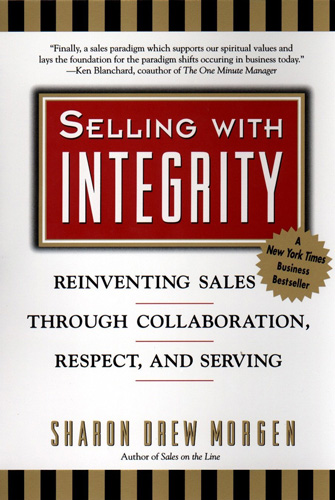
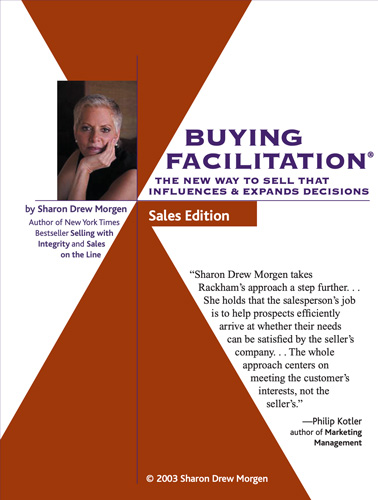
This book is very very different from Sales on the Line, Selling with Integrity and Buying Facilitation®. While those books talk about the buying decision process as being separate from the sales process and introduce some new skills, none of my previous books delve into exactly, EXACTLY what happens behind the scenes. I have thoroughly explained

Read the rest of this entry »

  • Digg
  • Facebook
  • Twitter
  • LinkedIn
  • Mixx
  • MySpace
  • Delicious
  • StumbleUpon
  • Google Reader
  • Share/Bookmark

Buying Decisions: What Happens Behind-The-Scenes

behind the scenesFor some reason, it’s very difficult for sales people to think beyond ‘need’ and ’solution:’  We tend to think that because the buyer’s need matches our solution, and because we’re professionals who ‘care,’  the only thing buyers need to do is choose our solution.

But if it were that easy, buying decisions would get made more often in our favor. We certainly would not lose as many sales as we do. The problem is that the buying decision is so, so much more complex than we can imagine as we stand on the outside looking in.

Sales mysteriously treats an Identified Problem (my word for ‘need’) as if it were an isolated event. But it’s not. There are ramifications to any change, and the ramifications are ones only buyers can see from the inside and we will never be privy to.

Read the rest of this entry »

  • Digg
  • Facebook
  • Twitter
  • LinkedIn
  • Mixx
  • MySpace
  • Delicious
  • StumbleUpon
  • Google Reader
  • Share/Bookmark