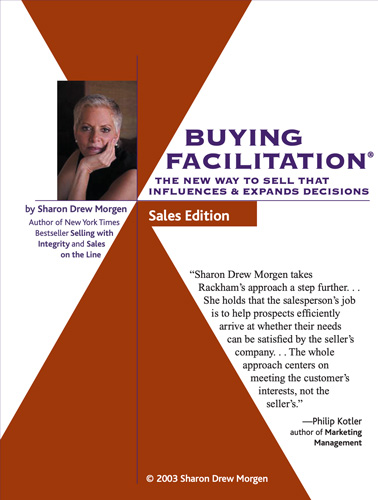
The Job of Sales Must Expand

Sales is a needs assessment-problem discovery/solution placement model. We use relationships and industry knowledge and well-conceived product data to align with prospects to help influence them to choose us.

Now, with technology, we have even more capability to offer product data and find our what’s happening with the buyer. The internet, e-marketing, webinars, websites, are offering buyers whatever data they may need to choose. With our fabulous technology, we can track them, cookie them, send them stuff, entice them with blog posts. But at the end of the day, until or unless they make a purchase, we’ve done it all for naught.

Read the rest of this entry »

  • Digg
  • Facebook
  • Twitter
  • LinkedIn
  • Mixx
  • MySpace
  • Delicious
  • StumbleUpon
  • Google Reader
  • Share/Bookmark

Make the Phone your Best Friend

Do you believe that to close a sale you must ‘get in front of prospects?’  Why? Really. Have you ever asked yourself why? Do you tell yourself that you MUST have that eye contact? That ‘face-to-face’ juice? Do you tell yourself that if you’re not in the field, you’re not selling?

In 1937, Dale Carnegie advocated it. What else are you using from a 1937 playbook?

Untold billions of dollars have been misspent following this industry-wide belief: planes, hotels, time. And? The industry still has a 7% average close rate.

Here is a rule: Don’t use your body as a prospecting tool.

Here is a secret: your sterling personality, your great outfit, your Rolex watch and Prada shoes don’t close an account. Nor does your great insight or knowledge of the buyer, their need, your industry, or your solution. Nor does that great rapport you create over lunch. Otherwise, you would be closing a lot more sales. Amazing how much push-back I get from an industry with such a low success rate.

Read the rest of this entry »

  • Digg
  • Facebook
  • Twitter
  • LinkedIn
  • Mixx
  • MySpace
  • Delicious
  • StumbleUpon
  • Google Reader
  • Share/Bookmark

How to Find the Right Prospect: know who will buy on your first call

searchingHow often have you chased a prospect for weeks/months/years and then got a ‘no?’ How much time have you wasted that you could have used for finding prospects who would become clients? And how much time have you spent waiting for prospects that either never showed up again, or who took far, far too long to close, while you sat waiting and wondering – or worse, chasing them or reducing the price to get them to buy because you thought they should have closed already??

Do I have your attention? Great. Let me tell you a story.

At a client site recently, as I was preparing to do real-time calls with the program participants, they set up a situation in which I would call a recent (failed) prospect and pretend I was a trainee. The thinking was that the team would hear me use Buying Facilitation® in a non-threatening situation since the prospect had already said ‘no’  after an eleven month sales cycle and three site visits and product trials.

Read the rest of this entry »

  • Digg
  • Facebook
  • Twitter
  • LinkedIn
  • Mixx
  • MySpace
  • Delicious
  • StumbleUpon
  • Google Reader
  • Share/Bookmark

Turning a ‘No’ into a ‘Yes’

I recently experienced a very clear example of Buying Facilitation(R), when i used it to turn a failed buying situation into a purchase.
I tell a shortened version of this story in my new book “Dirty Little Secrets;” it bears repeating during this economic confusion when buyers are having difficulty getting to ‘yes’.
I was at a client site running a Buying Facilitation(R) training. A part of the training includes real-time calls to clients prospects. In this situation, my client had requested that the team listen to me on a call first, so they could hear what BF actually sounded like real-time. They set up a phone meeting between me and a prospect who had called recently to say “Sorry. We won’t be purchasing your product,” after one year of 3 sales visits and 3 product trials.
These women that I called were the heads of L&D at a well-known university and were expecting my call. They had been told that I was a trainee who wanted to ask some questions to help me learn about the product and the buyer’s environment. They were happy to help.
I called (with everyone listening in), and after some intros and pleasantries, the conversation went like this:
SDM: It must have been so sad for you to have to decline purchasing the Solution when you loved it so much.
L&D: It was! We love your product! We really would have liked to have bought it.
SDM: What stopped you?
L&D: We have this new HR Director who is nearly impossible to work with. We ended up deciding that we’d make our lives easier and not fight with him. As a result, we’ve not fought him when he’s made decisions we’re not happy with, even though we should have an equal say and vote. It’s just not worth the hassle.
SDM: I hear you saying that the relationship issues you are having with a colleague are keeping you from making available possible tools to help your folks achieve a greater level of excellence.
L&D: Oh my. You’re right! Doesn’t sound very mature, does it?
SDM: What would need to happen differently to ensure the two of you could figure out a way forward to make sure your personal issues wouldn’t get in the way of necessary work decisions?
L&D: We’d have to figure out how to a start a dialogue and come to some professional resolution.
About three hours after this conversation, my client got a note from these women and asked to get some of ‘those questions’ (Facilitative Questions) so they could use them on the HR Director. I sent them, and within 3 weeks, the prospects purchased our product.
WHAT HAPPENS WHEN BUYERS SAY ‘NO?’
If these prospects didn’t like the product, they would have said ‘no’ days/weeks after first being introduced to it – not waited for 3 vendor visits and wasted time and manpower on 3 trials over 11 months. Obviously they liked the product, like the vendor, and needed the product. But they didn’t buy because of an internal relationship issue that was out of the realm of the sales model.
Does this happen to you? Do you have great relationships with your prospects who seem to recognize that your product will solve their need? Do you sit and wait for months and months for them to call back, believing you have a sale, and then they never call back, or call back to say ‘No?’
It’s not you. It’s not your solution, or your personality, or your skills, or your client relationship. It’s the sales model. Sales merely deals with the solution-placement end of the buyer’s final decision and has no skills to help the buyer make sense of the internal, idiosyncratic stuff that seems so difficult for them to handle…..those relationship and policy and personality issues that have created the status quo and keep it in place daily, the ones you know nothing about and are not part of their problem or your solution.
As you saw in the story above, until buyers manage their internal decision and relationship issues, they will take no action: the ramifications of change are worse than maintaining the status quo (I write extensively about this in my new book). We’ve always sat and waited impatiently for them to achieve an internal decision, frequently attempting to ‘get in’ during this quiet time, and try to make something happen, when unfortunately it’s out of our control.
But you can maintain some influence and control right from the first conversation (see blog of Friday December 4). Doing this does the following:
1. it puts you on the Buying Decision Team immediately;
2. it differentiates you from the competition;
3. it discovers those who cannot buy immediately;
4. it makes it possible to have a bit of control around what’s happening when  you’re not around;
5. it gets rid of all objections (price and otherwise).
How would you know when you’d be willing to add a new skill set to what you’re already doing successfully? And what would you need to understand about Buying Facilitation(R) to know if the model would work in your client environment?
sd

no-to-yesI recently experienced a very clear example of Buying Facilitation®, when i used it to turn a failed buying situation into a purchase.

I tell a shortened version of this story in my new book, Dirty Little Secrets; it bears repeating during this economic confusion when buyers are having difficulty getting to ‘yes’.

I was at a client site running a Buying Facilitation® training. A part of the training includes real-time calls to clients prospects. In this situation, my client had requested that the team listen to me on a call first, so they could hear what BF actually sounded like real-time. They set up a phone meeting between me and a prospect who had called recently to say “Sorry. We won’t be purchasing your product,” after one year of 3 sales visits and 3 product trials.

These women that I called were the heads of L&D at a well-known university and were expecting my call. They had been told that I was a trainee who wanted to ask some questions to help me learn about the product and the buyer’s environment. They were happy to help.

Read the rest of this entry »

  • Digg
  • Facebook
  • Twitter
  • LinkedIn
  • Mixx
  • MySpace
  • Delicious
  • StumbleUpon
  • Google Reader
  • Share/Bookmark

Overcoming the Stall: what takes buyers so long to buy?

questionMarkAre your sales taking too long to close? Do you know why?

Is it you? Is it your prospect? Is it your product?

And what would you need to do differently in order to close more quickly?

One of the biggest problems I hear sellers complain about is that it takes so long for buyers to finally buy. After all, you have a great product, you are a professional, you understand your prospect’s needs, and spend time on prospects who fit the profile. But for some reasons, too many sales stall. What is going on?

Read the rest of this entry »

  • Digg
  • Facebook
  • Twitter
  • LinkedIn
  • Mixx
  • MySpace
  • Delicious
  • StumbleUpon
  • Google Reader
  • Share/Bookmark

A New Presentation Model: Facilitate the Decision

presentationI know that a lot of you love to do presentations. When folks use Buying Facilitation® their presentations are not focused on presenting solution data, but rather helping prospect maneuver through their behind-the-scenes issues they need to manage before being able to choose a solution – and THEN they present whatever matches the buying criteria they all have discovered together.

Whenever we stand in front of a room and pitch data, we have no idea how the folks are viewing us or our solution, what the politics in the room are and how the personalities are weighted, how we are being perceived in relation to our competitors, their old vendors or their on-site team mates who are currently providing a work-around until a new solution gets chosen.

Read the rest of this entry »

  • Digg
  • Facebook
  • Twitter
  • LinkedIn
  • Mixx
  • MySpace
  • Delicious
  • StumbleUpon
  • Google Reader
  • Share/Bookmark