Decisions are Never Emotional
Oct 30, 2009 Sales Related
Imagine if instead of believing that unexpected decisions are emotional, we assume they have a very specific reason, even if we don’t understand or agree. Then what? Is it just easier to believe the other person to be irrational?
Do you remember, back in the day, when docs said that women suffering from PMS were hysterical and they needed to have a hysterectomy (that’s where the word ‘hysterical’ comes from btw)? They didn’t understand the physiology underlying the physical issues, and relegated the problem to emotions.
My son has a neurological disease called Dystonia. There is no physical/medical test for it (although it’s very obvious what it is if you are familiar with it), and for many years people suffered with it and had to go to mental institutions because it was called an ‘emotional’ disease. In fact, when I lived in London and my son needed his perscriptions filled from our NY neurologist, our ’surgery’ doc (the UK medical model) told us he needed a psychiatrist, not meds for his uncontrollable spasms.
Historically, when we don’t understand the roots of something we assume there is an emotional component, with the underlying belief being that there is something ‘not quite right’ with the person experiencing what is outside our comfort zone.
Read the rest of this entry »
Tags: beliefs, buying decisions, change, decisions, emotional, irrational, systems, unconscious
Why Open Questions Don’t Work
Sep 21, 2009 Sales Related, Top Posts
For decades, if not centuries, we’ve written books about, lectured about, and trained about, the virtues of Open Questions.
I’m here to denounce the myth that they are good in all instances: I actually believe they are used most effectively at the back end of the selling/buying cycle and have no role to play in the buying decision activity that occurs before buyers make their solution choice.
Let’s first consider why they are used at all. Questions, in and of themselves, create parameters for the questioned person. So if i asked you what you had for breakfast, you couldn’t tell me about a trip to visit your Mom. Questions effectively set the boundaries for your answer.
Open Questions give the questioned person a large field to answer in, making it possible for the person to think fully and expansively. In the field of sales, Open Questions are used to have prospects/buyers ‘open up’ and ’spill the beans’ so that sellers can gather the data they need to know to sell better. The word I hear a lot from sellers is that they want the prospect to ‘REVEAL.’
Read the rest of this entry »
Tags: buying decisions, Decision Facilitation, Dirty Little Secrets, Facilitative Questions, off-line decisions, open questions
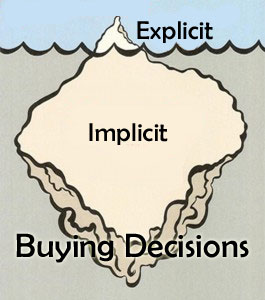
Buying Decisions: What Happens Behind-The-Scenes
Sep 14, 2009 Decisioning & Change Management, Top Posts
For some reason, it’s very difficult for sales people to think beyond ‘need’ and ’solution:’ We tend to think that because the buyer’s need matches our solution, and because we’re professionals who ‘care,’ the only thing buyers need to do is choose our solution.
But if it were that easy, buying decisions would get made more often in our favor. We certainly would not lose as many sales as we do. The problem is that the buying decision is so, so much more complex than we can imagine as we stand on the outside looking in.
Sales mysteriously treats an Identified Problem (my word for ‘need’) as if it were an isolated event. But it’s not. There are ramifications to any change, and the ramifications are ones only buyers can see from the inside and we will never be privy to.
Read the rest of this entry »
Tags: buyer, buying decision team, buying decisions, identified problem, isolated event, need, sales, seller, solution
What Is The Job Of A Seller?
Aug 7, 2009 Sales Related

I have a question: if your job is to get people to buy your solution, why do you spend so much time doing stuff that doesn’t bring in business?
I recently spoke with a sales guy who told me that for two years he’s been making appointments to do presentations for a relatively small ticket solution, and then waiting for a year before 30% of the the buyers purchased. His biggest challenge was getting the appointment. Do the numbers and it turns out that the first 90% of the prospects wouldn’t give him an appointment.
Why would anyone work so hard just to close 3% of their prospects? And why is he getting paid to waste so much time and resource? And And, why does he keep doing it that way if it’s a failed prospecting model?
Why? Because these sorts of low numbers are expected. Because that’s what sellers do. Because they’ve never learned the process of helping buyers manage their behind-the-scenes decisions they need to make.
Read the rest of this entry »
Tags: appointments, buying decisions, decision facilitator, offline, prospects, seller
What Is A Need?
Aug 5, 2009 Decisioning & Change Management

Since I’m the Queen Contrarian, I’d like to say that the ‘need’ we think that buyers have is not a real need.
First of all, we often meet them at the wrong end of their buying decision – when they are just starting their search for a possible solution. Not only have they not committed to making a purchase, they are too early in their decision process to fully understand all that their ‘need’ entails.
Tags: Buy-In, buyer, buying decisions, need, systems
Why Sales Fails
Jul 27, 2009 Sales Related, Top Posts
Why do so many of your good prospects not close? You’ve worked hard doing your sales job: you gathered good data and understood their need, you were a trusted advisor, they liked you and your solution. But they didn’t close.
Where did they go?
They went off-line. They went back to their teammates and their old vendors and their old solutions. They decided not to resolve the problem now. A new partner showed up with a fix that kinda resolved the problem. They decide to hire a new staff person with the funds.
In fact, you have no idea where the prospect went.
But I’ll tell you: They went to that place where you can’t go, to that private, off-line place that sales doesn’t give you skills for.
But it’s not your fault.
Read the rest of this entry »
Tags: buying decisions, prospects, sales
RSS