Two Days to Launch: a sneak preview of 3 of the Dirty Little Secrets

shhh they're secretsJust to whet your appetite, here are three of the  ’dirty little secrets’ from my the Conclusion of my new book. Enjoy.

2. Buyers will make no purchasing decisions until they get buy-in from the components (people, policies, initiatives, groups) that are in any way connected to, or adjacent to, their

Because we invariably meet our prospects before they have gone through their change activities and our sales cycle is longer than necessary, we enter at the wrong time, with the wrong focus, and get bad results.

Now we can be a support person at both ends of the buying decision: First, as a decision facilitator; next, as a solution provider.We will be able to help them recognize and manage their decision elements and be put on their Buying Decision Teams early on.

Read the rest of this entry »

  • Digg
  • Facebook
  • Twitter
  • LinkedIn
  • Mixx
  • MySpace
  • Delicious
  • StumbleUpon
  • Google Reader
  • Share/Bookmark

Why Sales Are Faltering In This Economy, And What To Do About It

Unbalanced_scales

IS IT TIME TO TRULY HELP BUYERS BUY?

There are actually two major things a buyer must do prior to making a purchasing decision. Of course they must ultimately choose a supplier and a solution (that’s the role of sales). But they also must manage all of the off-line, behind-the scenes change issues that must take place internally so they can get buy-in to bring aboard something new (i.e. a solution). And this idiosyncratic, off-the-cuff buying decision activity is not addressed by the sales model – and yet it takes up 2/3 of the time it takes a buyer to do all they have to do before they buy.

We cannot be a direct part of this process. We are not there: we are outsiders, the conversations happen between colleagues, and we are not a part of the buyer’s team. Sure, we know (and learn) how to be professionals, and care, and understand. Yet the time it takes buyers to come up with their own answers – not the ones we want them to have but answers based on the idiosyncratic needs of the internal system – is the length of the sales cycle.

One of the problems we’re having selling now is not about a buyer’s need, or our solution: it’s the internal, behind-the-scenes issues buyers are having difficulty managing internally.  And these issues are now very politically motivated and economy-driven.

Because sales only manages the solution/product placement end of the buying decision, it offers us no tool kit to help buyers manage the conversations that go on off-line, between departments, with old vendors, etc. And because it focuses on the very last thing buyers do – choosing  a solution – and not the nitty-gritty issues that cause buyers to buy (or not), we are basically out of control.

Read the rest of this entry »

  • Digg
  • Facebook
  • Twitter
  • LinkedIn
  • Mixx
  • MySpace
  • Delicious
  • StumbleUpon
  • Google Reader
  • Share/Bookmark

Buying Facilitation® Comes Before Sales

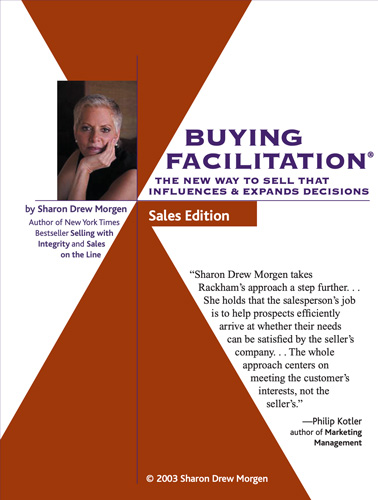
stabilityI’ve recently gotten a few notes from folks thinking that Buying Facilitation® is a way to help buyers make a buying choice once they are prospects. I’d like to correct you: Buying Facilitation® is NOT a selling tool; it is used BEFORE any selling happens, and is a change management tool.

Let’s look at it this way: if a buyer’s buying decision were a 3 inch line, the sales piece would be the last 1/2 inch. Let me  give you an example with the client I blogged about yesterday. 

Read the rest of this entry »

  • Digg
  • Facebook
  • Twitter
  • LinkedIn
  • Mixx
  • MySpace
  • Delicious
  • StumbleUpon
  • Google Reader
  • Share/Bookmark

A Case Study In Buying Facilitation®

goodpractice I’m at a client site this week (Good Practice), teaching them how to become decision facilitators.  As part of their training, I sit with each of them as they learn to make the phone their friend, and practice Buying Facilitation® on cold calls.

These sales folks are long-term professionals, responsible for millions of dollars of business annually. Yet they are discovering wholly new responses and possibilities for starting client relationships.

What are they doing differently from what they used to do? They are directing their efforts to supporting the off-line issues prospects have to address before they are in a position to consider making a buying decision. They are not using sales techniques. They are not gathering data, or understanding needs, or pitching. But their results are far more successful than if they were selling.

Read the rest of this entry »

  • Digg
  • Facebook
  • Twitter
  • LinkedIn
  • Mixx
  • MySpace
  • Delicious
  • StumbleUpon
  • Google Reader
  • Share/Bookmark

Buying Decisions: The Implicit Vs. The Explicit

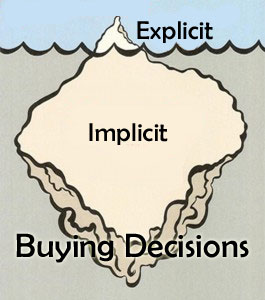
implicit-explicitWhen I began talking about ‘helping buyers buy’, or ‘decision facilitation’ in 1988, people thought I was a bit eccentric, to say the least. “I help buyers buy too,” I used to hear. “I find out what they need, position my solution in a way they understand that it will resolve their pain, and give them a good price.” And this has basically been the accepted norm throughout the history of sales. Except, of course, sales fails 90% of the time. So something is broken that we don’t really talk about.

What has finally become obvious (and I’d like to think that I had something to do with it being so obvious) is the yawning gap between the Implicit buying decisions buyers must make on their own, and the Explicit ones that sellers play such a large part in helping them make.

Read the rest of this entry »

  • Digg
  • Facebook
  • Twitter
  • LinkedIn
  • Mixx
  • MySpace
  • Delicious
  • StumbleUpon
  • Google Reader
  • Share/Bookmark

A ‘Need’ Doesn’t Mean A Buying Decision

A prospect of one of my coaching clients - the sales manager of a small manufacturing company – joined our coaching call at the request of my client Joe. Joe wanted me to use my Buying Facilitation method on the manager to find out why he hadn’t purchased a sales training program after 6 months of conversation, given he had an ’obvious need’, and the two of them had a ‘nice relationship’. I don’t know what my client told him to get onto the call, but the man showed up with great humor.

Read the rest of this entry »

  • Digg
  • Facebook
  • Twitter
  • LinkedIn
  • Mixx
  • MySpace
  • Delicious
  • StumbleUpon
  • Google Reader
  • Share/Bookmark