Why Sales Are Faltering In This Economy, And What To Do About It

Unbalanced_scales

IS IT TIME TO TRULY HELP BUYERS BUY?

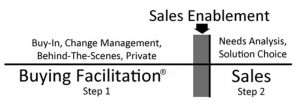
There are actually two major things a buyer must do prior to making a purchasing decision. Of course they must ultimately choose a supplier and a solution (that’s the role of sales). But they also must manage all of the off-line, behind-the scenes change issues that must take place internally so they can get buy-in to bring aboard something new (i.e. a solution). And this idiosyncratic, off-the-cuff buying decision activity is not addressed by the sales model – and yet it takes up 2/3 of the time it takes a buyer to do all they have to do before they buy.

We cannot be a direct part of this process. We are not there: we are outsiders, the conversations happen between colleagues, and we are not a part of the buyer’s team. Sure, we know (and learn) how to be professionals, and care, and understand. Yet the time it takes buyers to come up with their own answers – not the ones we want them to have but answers based on the idiosyncratic needs of the internal system – is the length of the sales cycle.

One of the problems we’re having selling now is not about a buyer’s need, or our solution: it’s the internal, behind-the-scenes issues buyers are having difficulty managing internally.  And these issues are now very politically motivated and economy-driven.

Because sales only manages the solution/product placement end of the buying decision, it offers us no tool kit to help buyers manage the conversations that go on off-line, between departments, with old vendors, etc. And because it focuses on the very last thing buyers do – choosing  a solution – and not the nitty-gritty issues that cause buyers to buy (or not), we are basically out of control.

Read the rest of this entry »

  • Digg
  • Facebook
  • Twitter
  • LinkedIn
  • Mixx
  • MySpace
  • Delicious
  • StumbleUpon
  • Google Reader
  • Share/Bookmark

Phones Are An Underutilized Business Tool

telephone

You hate to cold call, right?  Dale Carnegie taught us (in 1937) that we have to get in front of people to make a sale. In those days, there was no other way.

Yet we’re still listening to him, believing that getting in front of prospects will give us an edge – forgetting, of course, that everyone else is just as smart and friendly and oh-so-charming.

We put huge budgets aside for travel; the telephone is looked at disdainfully, as merely an appointment getting vehicle, not as the rapport builder and communication tool that it can be.

And even with the massive failure rate we have, we still focus every interaction on The Sale. We forget that if buyers can’t figure out how to manage those off-line decisions that take place in their workplaces, it doesn’t matter what we’ve got or what they need.

Read the rest of this entry »

  • Digg
  • Facebook
  • Twitter
  • LinkedIn
  • Mixx
  • MySpace
  • Delicious
  • StumbleUpon
  • Google Reader
  • Share/Bookmark

What Are Buyers Doing While We Wait?

waitingBuyers have lots to do before they buy. And it has little to do with your product or their need.

You know those times when buyers show up and, barely before you can ask them what they need, buy? That’s because they’ve already done what they need to do BEFORE they contact you and they are ready. Unfortunately, the majority of buyers don’t realize what they have to do until AFTER they’ve started discussions, leaving us to think they are in a position to buy. They aren’t.

Before I tell you what it is they must do before buying, I’d like to say that I’ve asked hundreds of people where their prospects go when they say “I’ll call you back?” Here are the responses I always get, and have gotten (the same ones) for decades. And in this order:

1. they are going to find a cheaper price; 2. they are checking out the competition; 3. they are checking us out.

Read the rest of this entry »

  • Digg
  • Facebook
  • Twitter
  • LinkedIn
  • Mixx
  • MySpace
  • Delicious
  • StumbleUpon
  • Google Reader
  • Share/Bookmark

Sales Treats A Need As If It Were An Isolated Event

buyingfacilitationWe all know that sales is a failed model; we’re good sellers and offer great customer service, our products are good, and our buyers have a need that we can fulfill. But we fail to close at least 90% of the time.

If it’s not us, not our product, and the need is obvious, what’s going on? Why don’t buyers know they’re supposed to buy?

The problem is the sales model. It’s broken. It treats the ‘need’ or the Identified Problem as if it were an isolated event, instead of recognizing that an Identified Problem is just one piece of a larger problem, and sits in a tangle of ’stuff’ that holds it in place in the buyer’s environment. What sales can’t manage is the mysterious route the buyer must go through to untangle the internal issues before they can make a decision to buy.

Read the rest of this entry »

  • Digg
  • Facebook
  • Twitter
  • LinkedIn
  • Mixx
  • MySpace
  • Delicious
  • StumbleUpon
  • Google Reader
  • Share/Bookmark

Changing The Paradigm: Is A 200% Increase In Sales Possible?

In the recent issue of Harvard Business Review, the editor Thomas Stewart, in his editorial, commented that in their article, Barry Trailer and Jim Dickie point out that “…customers’ buying processes have evolved in our world of ubiquitous, instant, global communication, but companies’ selling processes have for the most part stayed the same.’

I’m here to tell you that there is indeed a wholly original new sales process. But are you willing to change what you’re doing to get different results? My history of changing the sales paradigm over the past 16 years has told me that it’s highly unlikely that you are, and you’d rather keep the status quo and work around its inefficiencies (i.e. hire more sales people to make up the slack, cut back on training, reconfigure regions to save personnel) rather than change. And I find it perplexing.

Read the rest of this entry »

  • Digg
  • Facebook
  • Twitter
  • LinkedIn
  • Mixx
  • MySpace
  • Delicious
  • StumbleUpon
  • Google Reader
  • Share/Bookmark