Why Do We Blame Buyers?

I once told a group that I was going to title a book I’d Close More Sales if it Weren’t for the Buyer. I got a standing ovation! And I assumed I’d get a laugh. That’s like saying ‘I would have had a better birth experience if it weren’t for my mother.’

Why do we assume buyers are, um, stupid? Because it’s obvious to us they should buy. From where we stand, it seems we have THE perfect fit – the right solution at the right price, filling the right need, and the right relationship.

But we consistently forget that a buyer’s problem is not an isolated event, and it sits within the buyer’s environment – their system, if you will – all mashed up with a bunch of unknown and unknowable other elements that not only hold it in place, but maintain it daily.

Read the rest of this entry »

  • Digg
  • Facebook
  • Twitter
  • LinkedIn
  • Mixx
  • MySpace
  • Delicious
  • StumbleUpon
  • Google Reader
  • Share/Bookmark

Change is necessary. How can we make it fun?

These are heady days. Global business changes, environmental disasters, political upheavals. Change, Change, Change. Maybe it’s time to have another conversation about what change is. And at the same time, maybe discuss why it’s necessary to know how to change, since change is the only constant.

It’s a myth that change is difficult. Indeed, it’s not the change itself that’s difficult, it’s the underlying systems issues that balk, not the new idea or request. Here is why – and there is a very specific reason.

Systems – those interdependent rules, roles, politics, assumptions, and relationships, that make up the teams and families, companies and groups that we each belong to – are designed to operate as a whole, with all moving parts bought into the idiosyncratic rule that govern that entity.

Read the rest of this entry »

  • Digg
  • Facebook
  • Twitter
  • LinkedIn
  • Mixx
  • MySpace
  • Delicious
  • StumbleUpon
  • Google Reader
  • Share/Bookmark

Decisions are Never Emotional

emotional-decisionsImagine if instead of believing that unexpected decisions are emotional, we assume they have a very specific reason, even if we don’t understand or agree. Then what? Is it just easier to believe the other person to be irrational?

Do you remember, back in the day, when docs said that women suffering from PMS were hysterical and they needed to have a hysterectomy (that’s where the word ‘hysterical’ comes from btw)? They didn’t understand the physiology underlying the physical issues, and relegated the problem to emotions.

My son has a neurological disease called Dystonia. There is no physical/medical test for it (although it’s very obvious what it is if you are familiar with it), and for many years people suffered with it and had to go to mental institutions because it was called an ‘emotional’ disease. In fact, when I lived in London and my son needed his perscriptions filled from our NY neurologist, our ’surgery’ doc (the UK medical model) told us he needed a psychiatrist, not meds for his uncontrollable spasms.

Historically, when we don’t understand the roots of something we assume there is an emotional component, with the underlying belief being that there is something ‘not quite right’ with the person experiencing what is outside our comfort zone.

Read the rest of this entry »

  • Digg
  • Facebook
  • Twitter
  • LinkedIn
  • Mixx
  • MySpace
  • Delicious
  • StumbleUpon
  • Google Reader
  • Share/Bookmark

Buyers Don’t Buy Because You Sell Well

top-secretBuyers buy when they want to resolve a business problem.

Buyers buy when all of the members of their decision team – all of the members – agree that it’s time to resolve a problem.

Buyers buy when their internal system – their culture – knows how to make room for something new without disrupting the status quo.

Buyers never buy on price unless everything looks equal.

Sales people waste their intellectual capital by merely focusing on pushing a solution: they know so much about the environment their product resides in that they can be true decision facilitators for buyers.

Read the rest of this entry »

  • Digg
  • Facebook
  • Twitter
  • LinkedIn
  • Mixx
  • MySpace
  • Delicious
  • StumbleUpon
  • Google Reader
  • Share/Bookmark

What Is A Need?

need

Since I’m the Queen Contrarian, I’d like to say that the ‘need’ we think that buyers have is not a real need.

First of all, we often meet them at the wrong end of their buying decision – when they are just starting their search for a possible solution. Not only have they not committed to making a purchase, they are too early in their decision process to fully understand all that their ‘need’ entails.

Read the rest of this entry »

  • Digg
  • Facebook
  • Twitter
  • LinkedIn
  • Mixx
  • MySpace
  • Delicious
  • StumbleUpon
  • Google Reader
  • Share/Bookmark

Price Objections Aren’t Price Objections

money bag

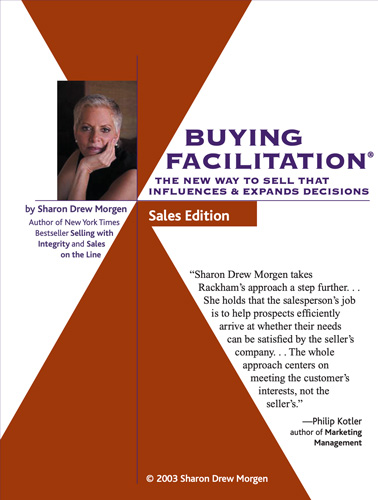
Recently, a CEO of a smallish company – a man familiar with my books - called me to do some work. Given the difficult market, he wanted to use Buying Facilitation® to differentiate from his competition, and have his existing customers buy more product.

As with everyone, I led him down the buying decision funnel and he figured out 1. how he needed to go about getting buy-in from his managers; 2. how he’d know before we started that he’d have a good chance of getting the results he desired; 3. how he’d recognize the value of any money expenditure.

Through the questions, he realized the managers who would have to be involved with the decisions to bring me in, what he and I would need to do prior to any training to give him the best shot at success, and what he’d walk away with when we were done.

Read the rest of this entry »

  • Digg
  • Facebook
  • Twitter
  • LinkedIn
  • Mixx
  • MySpace
  • Delicious
  • StumbleUpon
  • Google Reader
  • Share/Bookmark